
How Retail Identity Verification Reduces Chargebacks and Friendly Fraud
Chargebacks represent one of the most persistent financial drains in retail, both online and in high-value in-store transactions. When a customer disputes a charge with their bank, the merchant loses not only the sale revenue but also the product, the fulfillment cost, and an additional chargeback fee. The problem is compounded by the fact that a significant share of chargebacks in retail are not the result of genuine unauthorized transactions. They are the result of friendly fraud, where a customer who made a legitimate purchase disputes the charge anyway, knowing that merchants often lack the evidence needed to win the dispute.
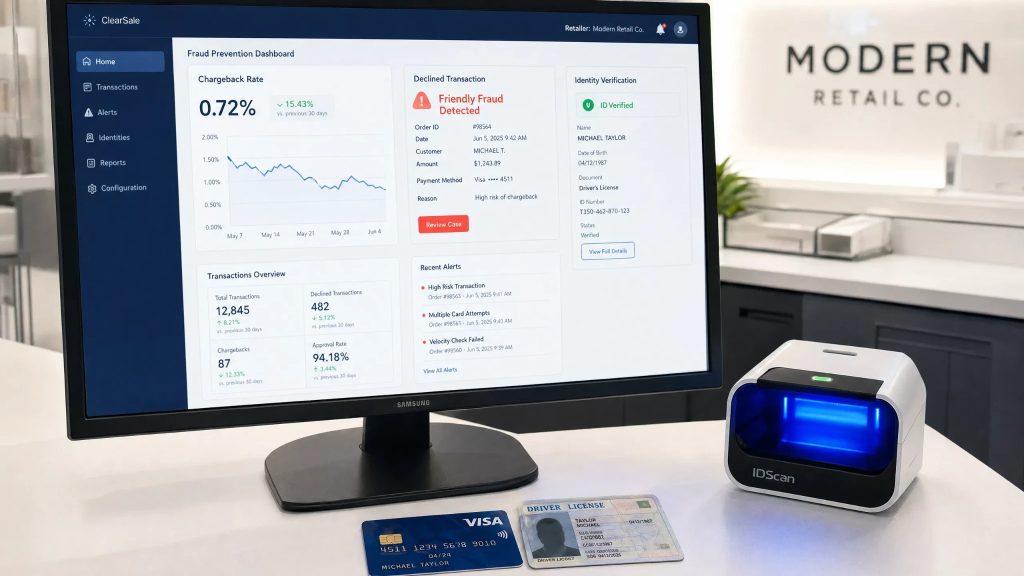
The structural weakness that enables both fraud types is the same: at the point of sale or checkout, the merchant typically cannot confirm with certainty that the person making the purchase is who they claim to be. Retail identity verification addresses this gap by introducing a documentable link between the transaction and the verified identity of the person conducting it. When this link exists, merchants have the evidence needed to dispute false claims and, more importantly, to deter the behavior before it occurs.
What Is Retail Identity Verification?
Retail identity verification is the process of confirming the identity of a customer at the point of purchase or account creation, using government-issued identity documents, biometric data, or a combination of both, and retaining a structured record of that confirmation as part of the transaction evidence. In other words, it creates a documented connection between a transaction and a verified identity that can be produced as evidence in a dispute.
In practice, retail identity verification can operate at several levels of intensity depending on the risk profile of the transaction.
- Document scanning at checkout: the customer’s identity document is read and the extracted data is associated with the transaction record. This is particularly applicable to high-value in-store purchases and click-and-collect order collection.
- Digital onboarding verification: for e-commerce accounts, the customer’s identity is verified at registration using document OCR and facial matching, creating a verified identity record that is linked to all subsequent purchases from that account.
- Step-up verification for high-value orders: transactions above a defined threshold trigger an additional identity confirmation step, such as a document scan or biometric re-authentication, before the order is processed.
- Delivery identity confirmation: for high-value goods delivered to a residential address, the delivery agent verifies the recipient’s identity document at the door and records the confirmation as part of the delivery proof.
What is also important here is that the verification record itself, not just the verification event, is what creates protection against chargebacks. A logged, timestamped record showing that the transaction was completed by a verified identity holder is the evidence that matters in a dispute resolution process.
How Retail Identity Verification Reduces Chargebacks
Chargebacks arise from two distinct situations, and identity verification affects each through a different mechanism. Understanding this distinction helps merchants apply verification at the right points in the transaction flow.
Genuine Unauthorized Transaction Fraud
When a fraudster uses stolen card credentials to make a purchase, the legitimate cardholder has grounds to dispute the transaction because they did not authorize it. Identity verification at the transaction level prevents a significant share of these purchases from completing. A fraudster who possesses stolen card details but cannot produce a matching identity document or pass a biometric check will be unable to complete a transaction that requires verification.
This positively affects chargeback rates by removing a category of transactions that would almost certainly result in disputes. The fraudulent purchase never completes, so there is no chargeback to process.
Friendly Fraud and False Dispute Claims
Friendly fraud occurs when a customer who made a genuine, authorized purchase disputes the transaction with their bank, claiming either that they did not make the purchase or that the goods were not received. This type of fraud is particularly damaging because the merchant delivered the product in good faith and has no immediate evidence to counter the claim.
Identity verification creates that evidence. When a transaction is linked to a verified identity record, including document scan data, a facial match result, and a timestamp, the merchant can present this documentation in the chargeback dispute process to demonstrate that the purchase was made by the verified account holder. Thanks to this documentation, a large proportion of friendly fraud disputes can be successfully challenged.
The Deterrence Effect
Apart from its direct effect on dispute outcomes, identity verification has a meaningful deterrent effect. Customers who know that their identity has been verified and recorded at the point of purchase are significantly less likely to attempt a false dispute, because they are aware that the merchant holds evidence connecting them to the transaction. That’s why the reduction in friendly fraud chargebacks often exceeds what can be explained by the disputes actually won; it includes disputes that are never filed in the first place.
Where Retail Identity Verification Has the Greatest Impact
Not every retail transaction warrants identity verification. The cost and friction of verification must be proportionate to the risk and value at stake. The following scenarios represent the highest-value applications.
High-Value In-Store Purchases
Electronics, jewelry, luxury goods, and high-end clothing represent categories where the transaction value is high enough to justify a brief document scan at the point of sale. Here is when identity verification enters the game as a natural complement to the existing purchase process: the scan takes under 10 seconds, creates a verified transaction record, and substantially reduces the merchant’s exposure to post-purchase disputes.
Click-and-Collect Order Collection
Click-and-collect orders present a specific fraud risk: an order placed with stolen credentials can be collected in person, leaving the legitimate cardholder to dispute the charge after the goods are gone. Requiring identity verification at the collection point confirms that the person collecting the order is the account holder, and records this confirmation as part of the transaction audit trail.
High-Value E-commerce Account Onboarding
E-commerce merchants selling high-value goods can verify customer identity at account registration rather than at each transaction. Given this upfront investment, the merchant gains a verified identity record that covers all future purchases from that account, creating ongoing chargeback protection without adding friction to individual checkout flows.
Subscription and Recurring Payment Setup
Subscription merchants face a specific category of friendly fraud where customers dispute the initial charge or subsequent recurring charges while continuing to use the service. Identity verification at subscription signup creates a verified record of the customer’s consent to the recurring payment, which is among the strongest available forms of evidence in recurring billing disputes.
What a Reliable Retail Identity Verification Solution Should Have
Merchants evaluating identity verification solutions for chargeback reduction should assess capabilities across accuracy, evidence quality, and integration dimensions. The following criteria define a production-ready solution for the retail context.
- Timestamped, tamper-evident verification records. The verification record associated with each transaction must include a reliable timestamp and be stored in a format that cannot be modified after the fact. This is the documentation that will be presented in a dispute, and its integrity must be beyond question.
- Structured output compatible with dispute management systems. Verification results should be exportable in formats accepted by chargeback management platforms and payment processor dispute workflows. We recommend verifying this compatibility before selecting a solution.
- Fast processing time at the point of sale. In a retail environment, verification must complete within 10 seconds to avoid disrupting the transaction flow. You should attentively analyze performance on the specific hardware that will be used in the retail environment, not only on reference devices.
- Multi-document type support. The solution should handle passports, national ID cards, and driver’s licenses from the document types most common in the customer base. The most widely used options are solutions that cover documents from 100 or more countries for retailers serving international customers.
- Facial matching for high-risk transaction tiers. For transactions above a defined value threshold, the solution should support optional biometric matching to confirm that the person presenting the document matches the document portrait. This provides a stronger evidence record than document data alone.
- Integration with POS and e-commerce platforms. Typical integrations include point-of-sale systems, e-commerce checkout platforms, order management systems, and delivery confirmation workflows. The solution should offer standard API connections for these environments.
How to Implement Retail Identity Verification for Chargeback Reduction
A successful implementation requires decisions about where in the transaction flow verification should occur, what evidence needs to be retained, and how that evidence connects to the dispute management process. The following steps outline the key considerations.
- Map the transaction types with the highest chargeback exposure. Before deploying verification broadly, analyze chargeback data to identify which product categories, order values, and customer segments generate the highest dispute rates. It will be helpful to focus initial deployment on these high-exposure areas rather than applying verification uniformly across all transactions.
- Define verification tiers by transaction value. Not every purchase warrants the same level of verification. We recommend establishing value thresholds that trigger progressively stronger verification requirements, for example, document scan above a moderate threshold and facial matching above a higher threshold.
- Connect verification records to transaction IDs in the evidence system. Each verification event must be linked to a specific transaction identifier so that the verification record can be retrieved and presented in response to a specific chargeback. An unlinked verification record has limited evidentiary value.
- Train staff on the verification workflow and dispute evidence retrieval. Customer-facing staff need to understand how to initiate verification, handle customer questions about the process, and retrieve verification records when a dispute arises. The value of the system depends on this operational readiness.
- Review chargeback win rates after deployment. Track dispute outcomes for transactions that have associated verification records compared to those that do not. This analysis will quantify the return on the verification investment and provide the data needed to adjust verification thresholds over time.
Conclusion
Retail identity verification reduces chargebacks through two distinct mechanisms: preventing fraudulent transactions from completing in the first place, and creating the documented evidence needed to successfully challenge false dispute claims. Both effects contribute to a lower chargeback rate, with the deterrence effect often producing reductions that extend beyond the disputes that are actively contested.
From a financial perspective, the return on identity verification investment is measurable and direct. Chargeback losses, dispute processing fees, and the risk of payment processor penalties for sustained high chargeback rates all decline when verified transaction evidence is systematically captured. Retailers who implement verification at the right points in their transaction flow create a defensible record that protects revenue while maintaining a purchase experience that legitimate customers find reassuring rather than burdensome.